Overview
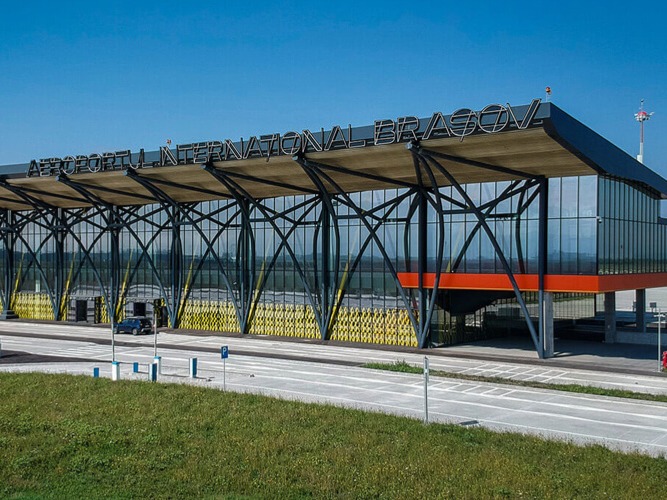
Brașov‑Ghimbav International Airport required the definition of a complete Air Navigation Services framework to enable safe and compliant operations, as no ANS infrastructure or operational concept previously existed. Airport Gurus delivered a comprehensive feasibility study defining the operational, technical, and regulatory foundations required to support airport opening and certification.
The assignment covered conceptual airspace and flight procedure design, ANS system definition, and evaluation of both conventional and virtual or remote tower solutions. The resulting study provided the contracting authority with a structured and defensible technical baseline to support procurement, safety justification, and transition to operational readiness.
Project Details
At the time of the study, Brașov‑Ghimbav International Airport was under development without an established Air Navigation Services framework. The airport is located in a mountainous environment characterized by constant terrain slope and dense surrounding aeronautical activity, including nearby heliports, the Ghimbav Aerodrome in close proximity to the runway, and multiple military restricted areas. These conditions required careful definition of airspace structures and flight procedures capable of supporting mixed civil, general aviation, and military operations in compliance with Romanian, ICAO, and EASA regulatory requirements.
Airport Gurus supported the project by developing the operational and technical concepts required to introduce Air Traffic Services at the airport. The feasibility study defined the ATS Concept of Operations and developed conceptual airspace structures and flight procedures, including conventional and Performance Based Navigation procedures. Particular attention was given to ensuring safe integration within the surrounding airspace environment and alignment with applicable regulatory frameworks.
The assignment also identified the systems, infrastructure, and staffing required to support ANS implementation. This included definition of ATS, CNS, MET, surveillance, and information systems, as well as operational space and staffing requirements for ATC, MET, and ATSEP functions. Both traditional tower and virtual or remote tower scenarios were assessed to support informed decision making on operational and investment strategies.
A structured system engineering review process was applied to ensure consistency between operational concepts, technical specifications, and regulatory requirements. The study delivered technical specifications, detailed bills of quantities, budget estimates, and scheduling inputs to support procurement planning and certification activities.
The engagement established a coherent and compliant ANS framework for a complex operating environment, reduced uncertainty associated with introducing services from a zero‑baseline condition, and provided the technical foundation required for procurement, certification, and airport entry into service.